

From napping to hibernating: uncovering what affects cellular sleep

Rodrigo de la Vega
I did not always know I wanted to be a scientist. I started college undecided and bounced around different classes without really understanding what scientific research involved. When I joined a lab, I was immediately met with a long string of failed experiments. At first this was very discouraging. Why would anyone choose a job where so much just doesn’t work? I realized though, as the people around me brushed off setbacks, that this is a normal and valuable part of discovery.
Solving puzzles piece by piece
Once I learned to embrace what I had once seen as failure and reframe it as a stepping stone, it opened my eyes to what a privilege and joy a career in science can be. I found my stride when I realized I could blend my interest in data science with my love of biology. Working with large datasets feels like sorting through the edge pieces of a puzzle and assembling the border. By uncovering patterns in gene expression or narrowing thousands of drug candidates down to a promising handful, I start to outline the shape of the bigger picture. With experience at the bench as well, I love that I can then carry those insights back into the lab and begin testing the individual pieces to see which ones truly fit. As a PhD candidate, I now use this combined approach, building the puzzle from both the computational and experimental sides, to study an interesting question: how cells decide when to rest.
What puts a cell to sleep, and what makes it wake up again?
Most of the cells in our bodies aren’t actively dividing, they’re in a “sleeping” state known as quiescence. Cells knowing when to go to sleep and when to wake up is essential for keeping tissues healthy. For example, entering the sleeping state can help prevent uncontrolled cell growth that could lead to cancer, and waking up cells in response to injury enables regeneration. To ensure proper responses by the right type of cells at the right time, sometimes cells sleep lightly and can wake up quickly, while other times they enter a deeper sleep and are much harder to waken. Understanding what controls this “depth of sleep” is the focus of my research as part of Dr. Guang Yao’s lab in the U of A’s molecular and cellular biology department.
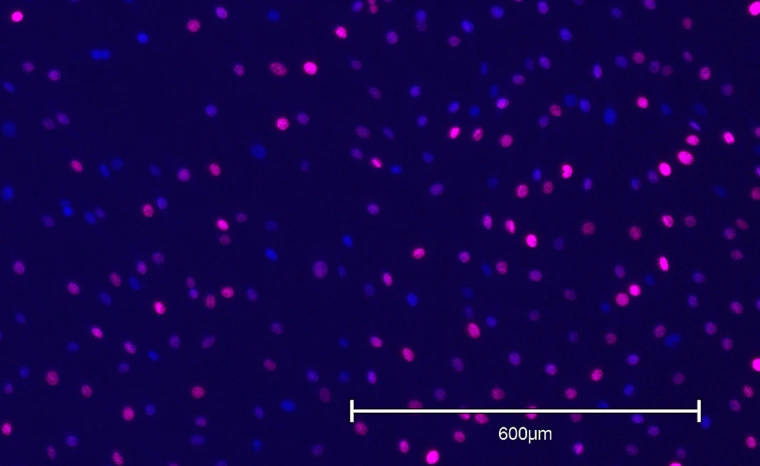
Which cells woke up? In this microscope image of cells in a dish, each dot is one cell. Blue marks cell nuclei, while pink marks cells that woke up and started copying their DNA to divide. Blue-only cells stayed asleep. Scale bar is about 6 human hairs.
Our lab designed a large drug screen that tested more than 2,500 FDA-approved compounds on cells placed into a sleeping state by removing growth signals. By measuring how easily the cells woke up after each treatment, the screen created a massive dataset that captures how each drug shifts the depth of cellular sleep. I am analyzing this dataset to identify the drug candidates that impact depth of sleep the most, and try to understand how they do it.
While I still need further validation before diving into any drug compound in particular, the dataset is already revealing exciting high-level leads. A set of inflammation related drug targets shows especially strong effects on dormancy depth. I am now going back to the lab to try to understand how and why these inflammatory signals hold such powerful control over cellular sleep.
As I enter the third year of my PhD, the story is turning out to be more complex than I expected. It seems like the same inflammatory signals can have opposite effects on sleep depending on the cellular context. To better understand how, I am treating otherwise identical cells in a dish with two closely related inflammation-associated drugs that have differing effects on sleep depth and using a technique that captures a snapshot of every gene the cells are switching on at a given time, RNA sequencing. Comparing these snapshots will reveal which signals and processes each drug activates, and how they might push cells into deeper or lighter sleep. Although this complexity adds challenges to my work, it is promising for the wider goals of the project. It suggests that we may eventually be able to treat specific cells with drugs that adjust only their depth of sleep without disturbing the rest of the body. For example, if cancer cells rely on unique ways of controlling their dormancy, we may be able to push only those cells into a deep, hibernation-like sleep and prevent them from waking up, while leaving nearby napping cells available for regeneration.
This work also connects closely with my long-term career goals. While I am currently focused on understanding what controls dormancy depth in healthy cells, I hope to one day start my own lab as a professor where I can continue using both experimental and computational tools to explore how these regulatory processes go awry in aging, cancer, and other diseases. By uncovering how cells lose control of their sleep states in different contexts, I hope to contribute to new strategies for improving human health and to expand our understanding of dormancy across many biological systems.