

MCB Student Spotlight: Collin Brown
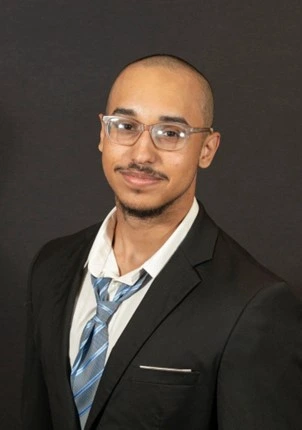
From playing with frogs in the pond to researching bats in a lab, one student’s passion for science, discovery, and curiosity has never wavered.
Originally from West Chester, Pennsylvania, Collin Brown, 20, has come very far to attend the University of Arizona. In the fall of 2023, Collin was a neuroscience major and a freshman. He took SCI 299 where Kara Dyson visited the class to talk about the MCB major. Kara truly inspired him, and he joined MCB major shortly after.
Last year, as a sophomore, Collin was searching for a research opportunity when he saw a flyer for the McNair Program, which is under the Undergraduate Research Opportunities Consortium or UROC. UROC is a graduate school preparation program, run by the University of Arizona’s Graduate College.
More importantly, the program is specifically directed towards first generation college students. Growing up low-income, with five little sisters, and a father trying to provide for the family, it was difficult to plan for college. When Collin was accepted into University of Arizona, it was a great opportunity to explore, and his father unconditionally supported him every step of the way.
Collin decided to take the opportunity to begin his research journey and applied. After applying to UROC and McNair, he had an interview with the program director, Caitlin Rosario Kelly. A month later, Collin was accepted into the program. Then, he began searching for a research mentor and Dr. Melville Wohlgemuth, Ph.D., responded to his email within two hours.
To begin Collin’s research journey, he spent last summer in a lab with Mexican Free-Tailed bats. The goal was to observe dynamic movements of bats and how they use adaptability to guide spatial attention (how they use their ears), along with elevation and angles (body orientation), and flight patterns. He wanted to use bats as a model to understand the neurobasis of spatial attention, how it’s processed in the brain, neuroethology, and the study of neurocircuits of animals in natural environments.
Collin summarizes the research: “We are trying to understand how bats sequence their behaviors to reorient their spatial attention. It serves as a preliminary study to our optogenetic experiment. Since we do not understand the natural behavior of bat flight, we don't have a comparison group to work with when we do stimulation of the brain during their free flight.”
Since bats are auditory specialists and use echo location, it was necessary to let the bats perform natural behaviors in a lab setting. The goal was to find out and use basic science to understand spatial attention in natural environments. This idea was to appreciate basic science with no immediate practical use.
At the UROC conference this year, Collin was awarded UROC’s Outstanding Student Award. He had to give a speech for the award and became emotional. “I realized the award was not just about prestige, it was a testament for how far I have come because of support systems.” Even though he had prepared a speech, he set the paper face down and began to express himself. Collin stressed the importance of curiosity and getting rid of imposter syndrome. Since he had been inexperienced beforehand, he didn’t see the point in trying. However, he realized one crucial fact. “Being a good scholar is not about knowing everything, curiosity encourages exploration, and persistence to pursue it…”
After the summer of research, lectures, mock presentations, and feedback, the McNair conference at the University of New Mexico was finally commencing. The days were filled with networking, graduate school recruiters, and oral and poster sessions. Collin did an oral presentation for the conference, leaving with a McNair certificate of completion and an inspiration to be better for the future.
The most important thing Collin learned was: “You don’t have to know everything.” He urges students to take everything in and experience it all. A support system is necessary for success, Collin believes that no one does anything big on their own and UROC and McNair provided that for him.
He also wants to be “a bridge for curiosity” and provide accessibility for people who cannot get opportunities as easily. Collin states, “Research is not just a lab, it is inclusive for everyone regardless of background.”
Collin is currently a junior, an Undergraduate Research Ambassador, and an officer for the consciousness minor. He is in his second year with McNair and is looking for another institution this summer, maybe the REU at MD Anderson. He is also back in the same lab and trying to submit his research to a science journal by spring. His current project is a continuation from last summer.
After he finishes his B.S. degree, Collin plans to take a gap year for his master’s degree and apply to MD/PHD programs. In total, his school career will be around fifteen years. He aspires to be a physician’s scientist and research, treat, and diagnose patients. His goal is to find underlying causes for various ailments and illnesses, such as cancer.